Feed Market Trends 2026 (5 Key Takeaways)
Feed Market Trends 2026: 5 Key Takeaways from the Kemiex Annual Feed Report
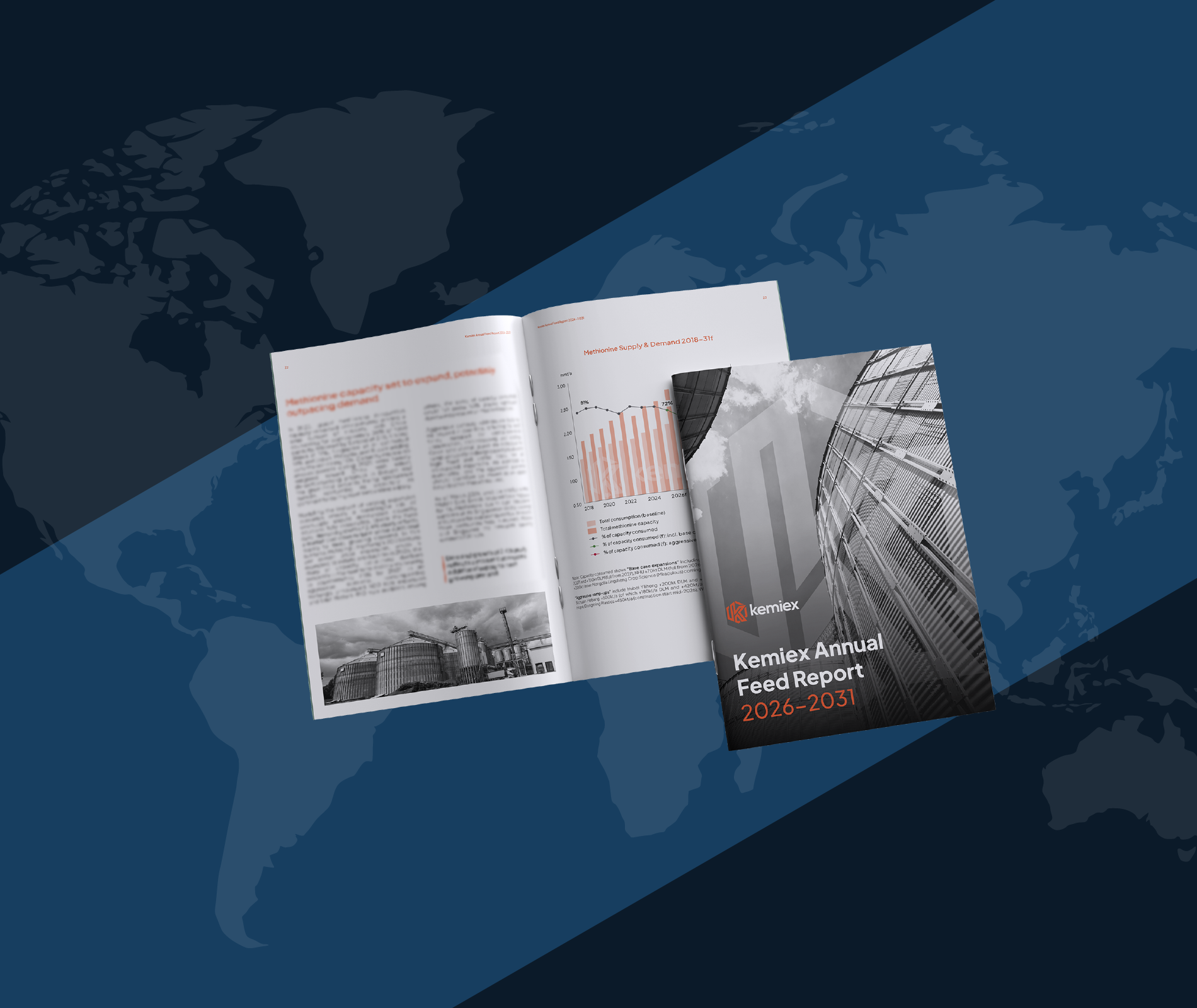
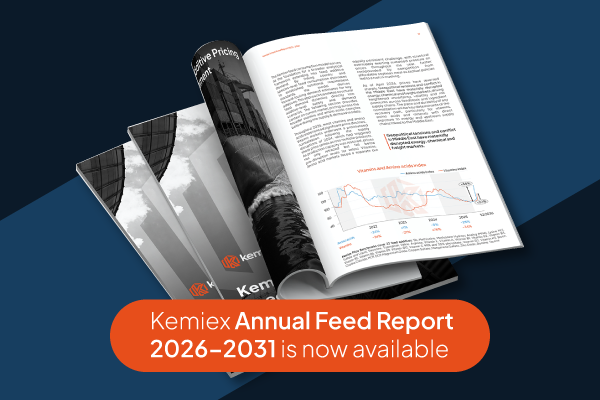
Kemiex has published the Annual Feed Report 2026-2031, a forward-looking read on global feed consumption, additive pricing and supply-demand scenarios. It is built on an econometric model spanning more than 130 countries and 45+ years of data, and informed by a network of 9,000+ procurement professionals across 95+ countries. If you only have ten minutes, these are the 5 feed market trends 2026 worth taking into your next planning meeting.
Takeaway 1: Global feed consumption climbs to 1,560 mmt by 2031
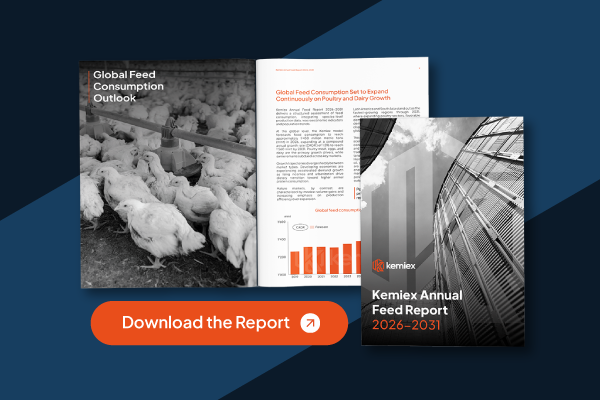
The Kemiex model has global feed consumption rising from roughly 1,450 million metric tonnes (mmt) in 2026 to 1,560 mmt by 2031, a 1.5% compound annual growth rate. Poultry meat, eggs and dairy do the heavy lifting; swine demand stays subdued across key markets.
What this means for procurement: plan for steady, predictable demand growth, and put your contingency planning somewhere else. The shocks that will actually disrupt your 2026 costs come from the supply side (capacity, energy, trade flows), not from demand surprising to the upside.
Takeaway 2: China, USA and Brazil drive 45% of global demand
Three nations account for nearly 45% of world feed demand in 2026. China leads at 336.6 mmt, the United States follows at 214.8 mmt (growing 1.3% a year through 2031), and Brazil is the fastest of the three at 98.1 mmt and 3.2% annual growth. The EU-27, by contrast, drifts slightly lower to about 201 mmt by 2031.
What this means for procurement: this concentration is a single point of failure for global pricing. A disruption in any one of the three (a Chinese capacity change, a US trade measure, a Brazilian crop year) propagates into the prices everyone else pays, even buyers who source nowhere near those markets. Map which of your key molecules trace back to each.
Takeaway 3: The vitamin market enters a new volatility cycle (+38% in H1 2026)
Through 2025, most vitamins and amino acids fell hard. Vitamin markets were normalising after the 2024 supply disruptions that had triggered sharp spikes, and for some products prices dropped below pre-disruption levels. Then the vitamin index turned and rose about 38% in the first half of 2026, marking a new volatility cycle, driven partly by Middle East conflict and Strait of Hormuz disruption working through energy, chemical and freight costs.
What this means for procurement: any budget locked to 2025 prices is already behind the market. More importantly, the swing was not a vitamin-specific event; it came through shared energy and freight inputs, so treat it as a signal to stress-test every energy-exposed molecule at once, not just vitamins.
Takeaway 4: Amino acid markets recover but face structural pressure (+17% in H1 2026)
Amino acids fought a different battle in 2025: structural oversupply held prices down all year, with affordable soybean meal piling on as biofuel policy drove a rush in crushing. The amino acid index then recovered around 17% in the first half of 2026, a bounce, but off a low base and against real headwinds. The report models lysine, threonine and methionine, the three molecules that drive most of the budget impact, and flags a genuine oversupply risk in methionine if the announced Chinese capacity additions all land.
What this means for procurement: the recovery does not mean the pressure is gone. Watch the soybean meal spread and the capacity pipeline together; if those plants ramp, methionine could roll back over even while demand grows, so resist locking long at the first sign of a rebound.
Takeaway 5: Supply-side risks reshape the buyer playbook
The supply side of both methionine and Vitamin E is moving in ways the market has not fully priced. On methionine, Evonik declared force majeure on DL-Methionine in March 2026 over tight propylene supply in Singapore, a reminder that a single upstream input can pull a major producer offline overnight, even as Chinese expansions threaten oversupply from the other direction. On Vitamin E, capacity is so concentrated in China that the whole market hinges on domestic cost and policy. Currencies, freight and energy round out the picture.
What this means for procurement: the lesson of 2026 is that supply, not demand, sets your risk. The report converts these signals into base, upside and downside scenarios for each molecule it covers, which is exactly the structure you need to turn ‘something might happen’ into a budget with triggers.
Where to find the full report
These five takeaways are condensed from the Kemiex Annual Feed Report 2026-2031. The full report adds country-level consumption tables, price-index history for the key vitamins and amino acids, methionine and Vitamin E supply-and-demand scenarios, regional analysis, and the macro indicators that move feed raw material prices.
Download the Annual Feed Report 2026
Used by 9,000+ procurement professionals in 95+ countries