You can build the AI. Can you build the intelligence behind it?
Building an AI agent has never been easier. Building the market intelligence it needs to deliver reliable, relevant answers is a very different challenge.
KAI vs Building Your Own, Opening Section
The intelligence behind the answer
An AI agent is only as good as the intelligence it can access.
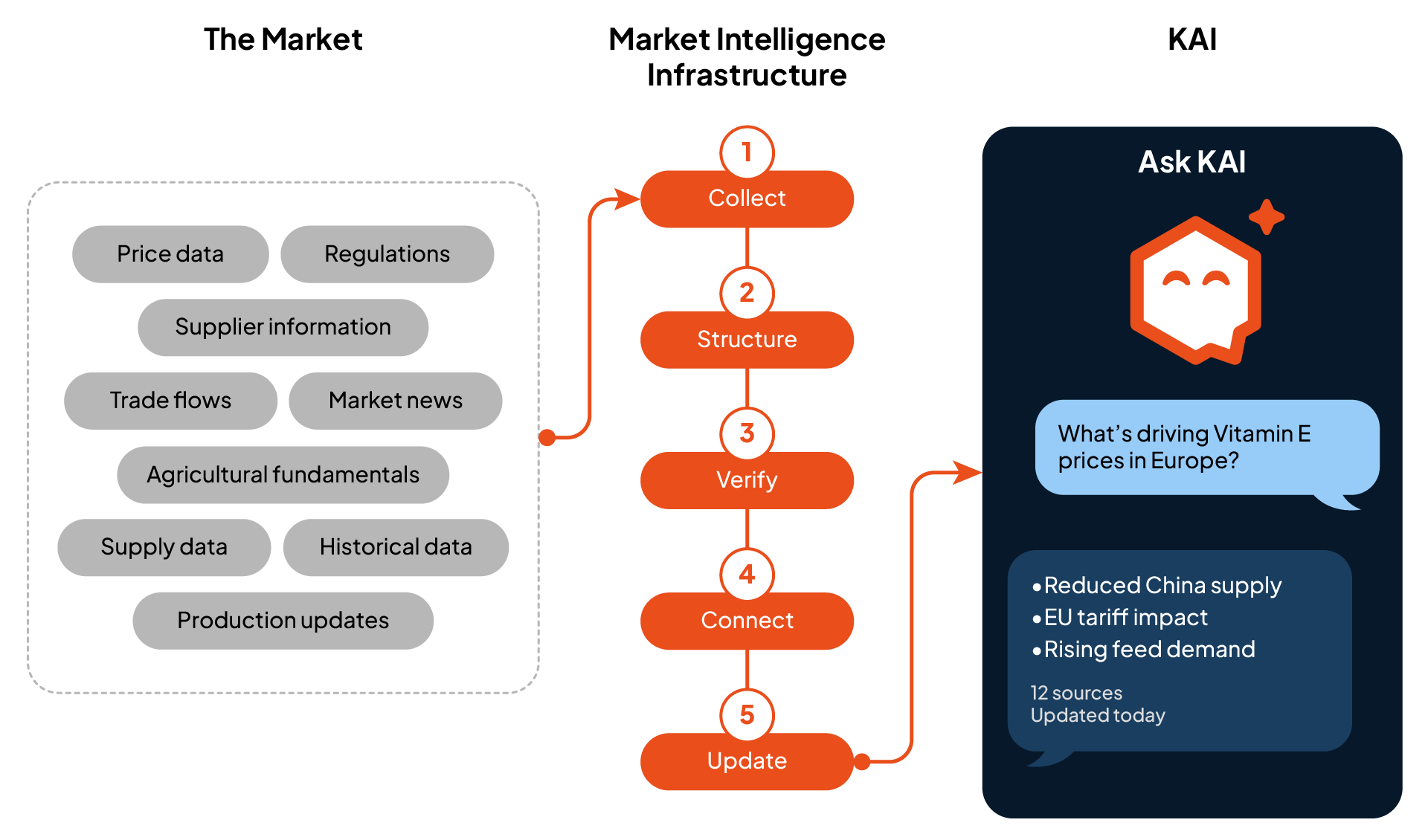
AI models are becoming increasingly powerful and accessible. But even the most capable model cannot analyze information it doesn’t have. And in feed and food raw materials, the information that matters is rarely sitting neatly in one place.
Much of it is difficult to find or contrast, difficult to compare, or simply not readily available online.
Connecting an AI agent to your own data can give it a deep understanding of what happened inside your business. But your own data only represents one view of the market.
Your own data
Tells you what happened in your business.
Market intelligence
Tells you what happened in the market.
That distinction matters when you benchmark a supplier quotation, evaluate alternative origins, understand price movements or decide when to act.
The real challenge isn’t giving AI the ability to answer questions. It’s giving it access to the right information to answer them well.
What Building Your Own Agent Actually Means
What building your own really involves
What does “building your own agent” actually mean?
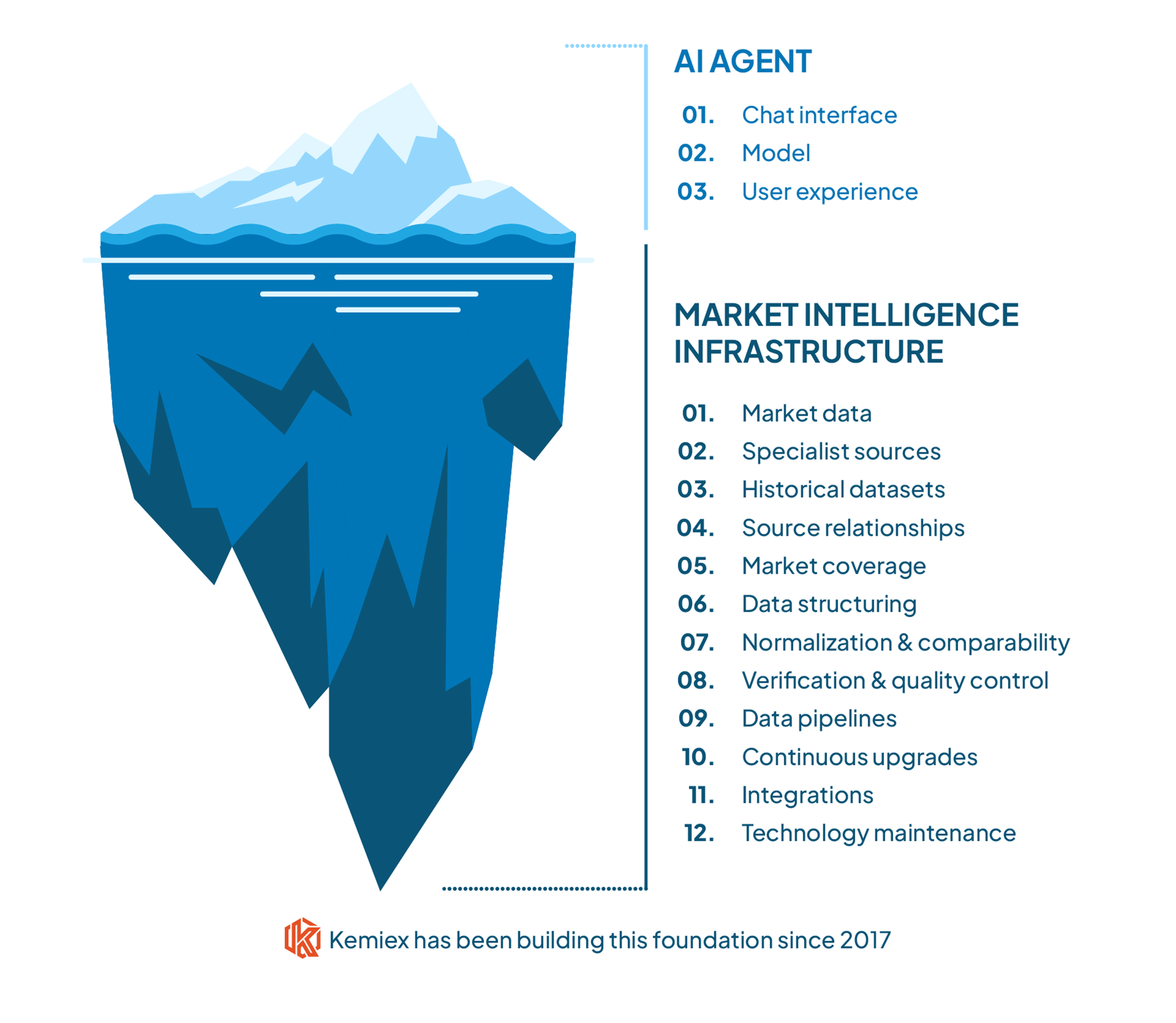
If you build an AI market intelligence agent internally, the agent itself may be the easiest part.
Behind it sits a much larger operation.
Building itConnecting the models, designing the retrieval layer, integrating internal and external sources, setting up data pipelines, defining permissions and testing the system until your team can rely on it in real business situations.
Maintaining itKeeping the technology stack, integrations and data pipelines running as models evolve, systems change and your organization changes with them.
Feeding it, indefinitelySourcing relevant information, establishing data relationships, structuring different formats, maintaining historical datasets, checking quality and continuously keeping the underlying intelligence current.
And someone has to own that job forever as an additional task, not just during the initial build, but every day that follows.
The agent is the visible part. The intelligence underneath is the real operation.
What Does It Take To Make It Work, Carousel
Five areas worth weighing up
What does it take to make it work?
Building the agent is one thing. Giving it the coverage, structure and continuity required to support real market decisions is another.
Here are five areas worth considering before deciding to build your own.
Access & market coverage
Building it yourselfYour internal systems hold company-specific data, but market intelligence requires a much broader view. Prices, supply developments, trade flows and production updates have to be sourced across products, regions and sources, much of it fragmented.
KAIGives you access to the market intelligence Kemiex has already built across the feed and food industry, combining multiple sources and datasets within one environment.
Why it matters:An AI agent cannot generate insight from information it cannot access.
Structure & comparability
Building it yourselfCollecting the information is only the beginning. Sources use different formats, terminology and methodologies, and even two prices for the same raw material may not be comparable without knowing their origin, specification, geography, timing and incoterm.
KAIWorks with market information Kemiex has already collected and structured for feed and food raw-material analysis, so data points can be read in their proper context.
Why it matters:More data doesn’t automatically mean better intelligence.
Freshness & continuity
Building it yourselfKeeping market intelligence current requires a permanent process. Prices, trade flows, production conditions and regulations change every day, and each source needs continuous monitoring, processing and maintenance.
KAIDraws on the same market intelligence infrastructure Kemiex continuously maintains for its customers. Keeping that information current isn’t an additional project, it’s Kemiex’s core business.
Why it matters:An outdated market intelligence agent may still produce convincing answers and you have no way of knowing.
Technology & maintenance
Building it yourselfModels evolve, APIs change, integrations and data pipelines need maintenance. What works today has to be monitored, tested and adapted as the technology and your internal systems change around it.
KAIThe models, infrastructure, integrations and data pipelines behind KAI are maintained as part of the product, so your team never operates the technology itself.
Why it matters:Launching an agent is a project. Keeping it reliable is an ongoing responsibility.
Ownership & economics
Building it yourselfThe initial development cost is only part of the investment. Data subscriptions, source relationships, engineering, infrastructure, testing and continuous data operations all need budget and ownership after launch.
KAIBrings the market intelligence, technology and maintenance together in one solution, without your organization having to build and operate a separate capability.
Why it matters:The real build-vs-buy question isn’t simply “What does it cost to build?” It’s “What are we committing to operate indefinitely?”
KAI Vs Build, Closing Block
What you are really choosing
The agent is the interface. The intelligence behind it is the advantage.
Kemiex has been building market intelligence infrastructure for the feed and food industry since 2017.
What those years have gone into
01Bringing together market data from multiple sources
02Building historical datasets
03Developing methodologies to structure and compare information
04Expanding and maintaining that intelligence as markets evolve
KAI is the conversational layer on top of that foundation.
So when you choose KAI, you’re not simply choosing an AI assistant. You’re accessing an intelligence infrastructure that has taken years to build, without having to build, feed and maintain it yourself.
Your team gets immediate access to a market intelligence assistant designed specifically around the markets you work in.
Available 24/7
Continuously updated information
Built for your markets
Wondering how KAI compares with general-purpose AI? Explore below.
Build the agent yourself, or access the intelligence from day one.
KAI gives your team conversational access to the market intelligence infrastructure Kemiex has spent years building, without having to build, feed and maintain it yourself.
We use optional cookies to improve your experience on our websites. If you reject optional cookies, only cookies necessary to store your preferences will be used.
Functional
Always active
The technical storage or access is strictly necessary for the legitimate purpose of enabling the use of a specific service explicitly requested by the subscriber or user, or for the sole purpose of carrying out the transmission of a communication over an electronic communications network.
Preferences
The technical storage or access is necessary for the legitimate purpose of storing preferences that are not requested by the subscriber or user.
Statistics
The technical storage or access that is used exclusively for statistical purposes.The technical storage or access that is used exclusively for anonymous statistical purposes. Without a subpoena, voluntary compliance on the part of your Internet Service Provider, or additional records from a third party, information stored or retrieved for this purpose alone cannot usually be used to identify you.
Marketing
The technical storage or access is required to create user profiles to send advertising, or to track the user on a website or across several websites for similar marketing purposes.