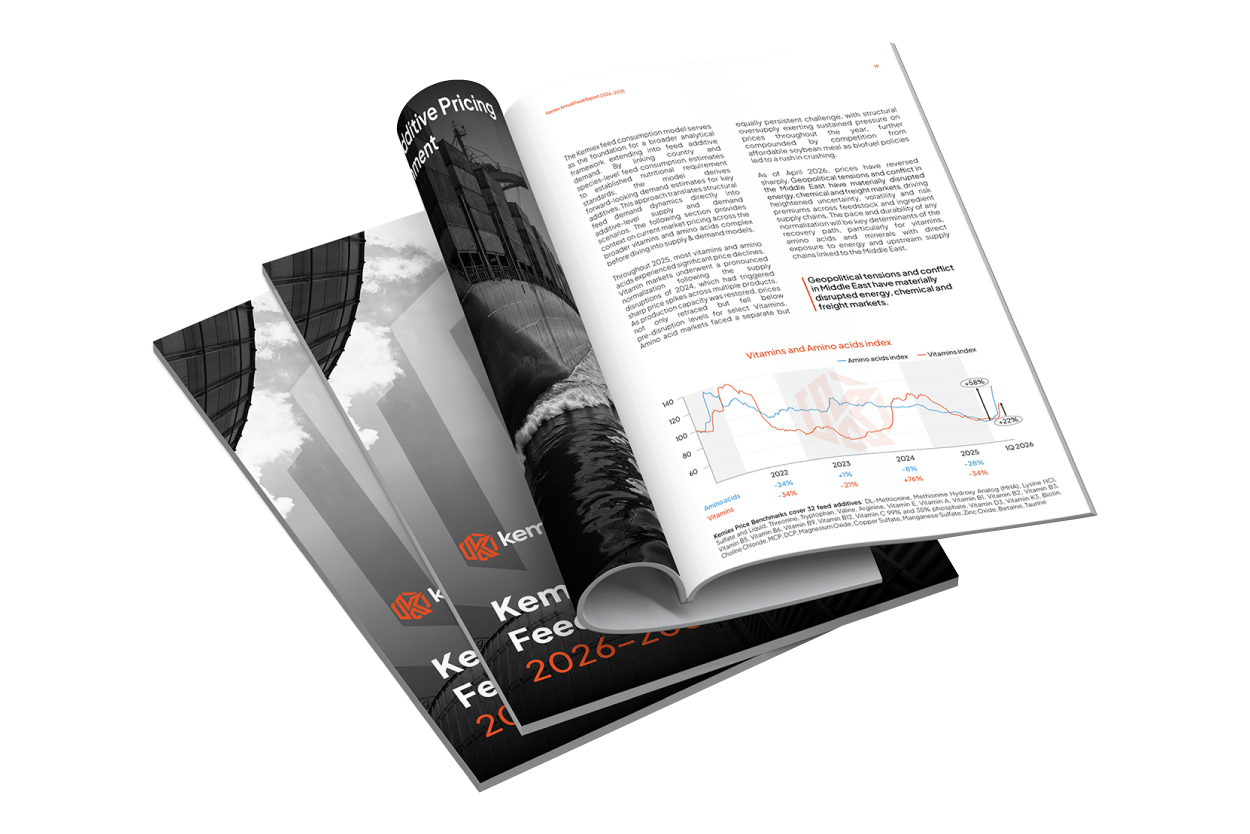
Kemiex Annual Feed Report 2026–2031
The animal nutrition industry is navigating one of its most complex periods in recent memory. Supply chains under pressure, volatile pricing across vitamins and amino acids, and demand growth that is anything but uniform across regions and species.
To help market participants cut through the noise, Kemiex has published its first Annual Feed Report – a forward-looking assessment of global feed consumption, additive pricing dynamics, and supply-demand scenarios for key micro ingredients through 2031.
Global Feed Consumption Set to Expand Continuously on Poultry and Dairy Growth
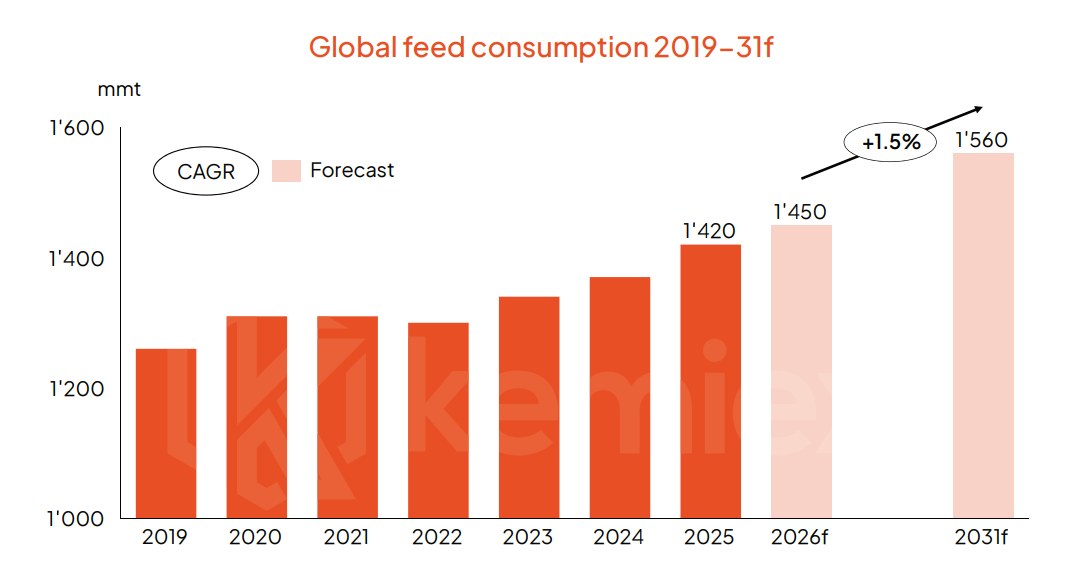
At the global level, the Kemiex model forecasts feed consumption to reach approximately 1’450 million metric tons (mmt) in 2026, expanding at a compound annual growth rate (CAGR ) of 1.5% to reach 1’560 mmt by 2031. Poultry meat, eggs, and dairy are the primary growth drivers, while swine remains subdued across key markets.
Growth trajectories diverge sharply between market types. Developing economies are experiencing accelerated demand growth as rising incomes and urbanization drive dietary transition toward higher animal protein consumption.
China, United States and Brazil remain largest feed consumers
Global feed consumption is highly concentrated, with the three largest consuming nations China, the United States, and Brazil accounting for nearly 45% of total world feed demand in 2026.
- China remains the world’s largest feed consuming nation by a considerable margin, with total consumption forecast at 336.6 mmt in 2026
- Total feed consumption in the United States is forecast at 214.8 mmt in 2026, with annual growth at 1.3% until 2031.
- Brazil ranks as the third largest feed consuming nation globally, with total consumption forecast at 98.1 mmt in 2026 and strong annual growth of approximately 3.2% forecast through 2031.
- Total feed consumption across the EU-27 is forecast at approximately 202 mmt in 2026, with demand outlook to remain essentially flat through 2031 at about 201 mmt
To see the full data on who’s driving the global feed demand, download the full report here.
Note: To download the report successfully, please add Kemiex as an exception in your ad blocker (if you use one).
Feed Additive Pricing Environment
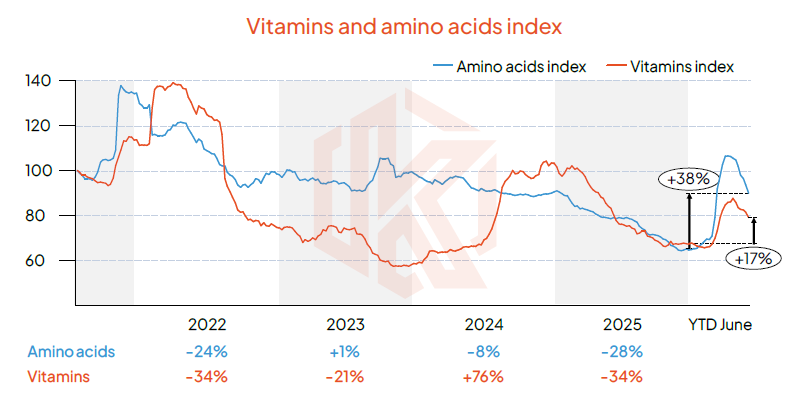
Throughout 2025, most vitamins and amino acids experienced significant price declines. Vitamin markets underwent a pronounced normalization following the supply disruptions of 2024, which had triggered sharp price spikes across multiple products.
As production capacity was restored, prices not only retraced but fell below pre-disruption levels for select Vitamins. Amino acid markets faced a separate but equally persistent challenge, with structural oversupply exerting sustained pressure on prices throughout the year, further compounded by competition from affordable soybean meal as bio fuel policies led to a rush in crushing.
The supply side of both Methionine and Vitamin E are also shifting in ways that are not yet fully priced in, and the scenarios we model point to outcomes that may surprise even seasoned market participants.
Whether you are buying, selling, or simply trying to stay ahead, you will want to see the numbers.
Download your copy of the report here.
Note: To download the report successfully, please add Kemiex as an exception in your ad blocker (if you use one).