Key Takeaways
- Pork and chicken are tied within 1,334 MT worldwide, on a combined base of over 249 million MT, the closest race between any two categories at global scale.
- China’s own output is split almost evenly between pork and fish from aquaculture, a gap of under 3%.
- Argentina is the only country in the top ten led by beef, at 3.29 million MT, or 52% of its 6.34 million MT total.
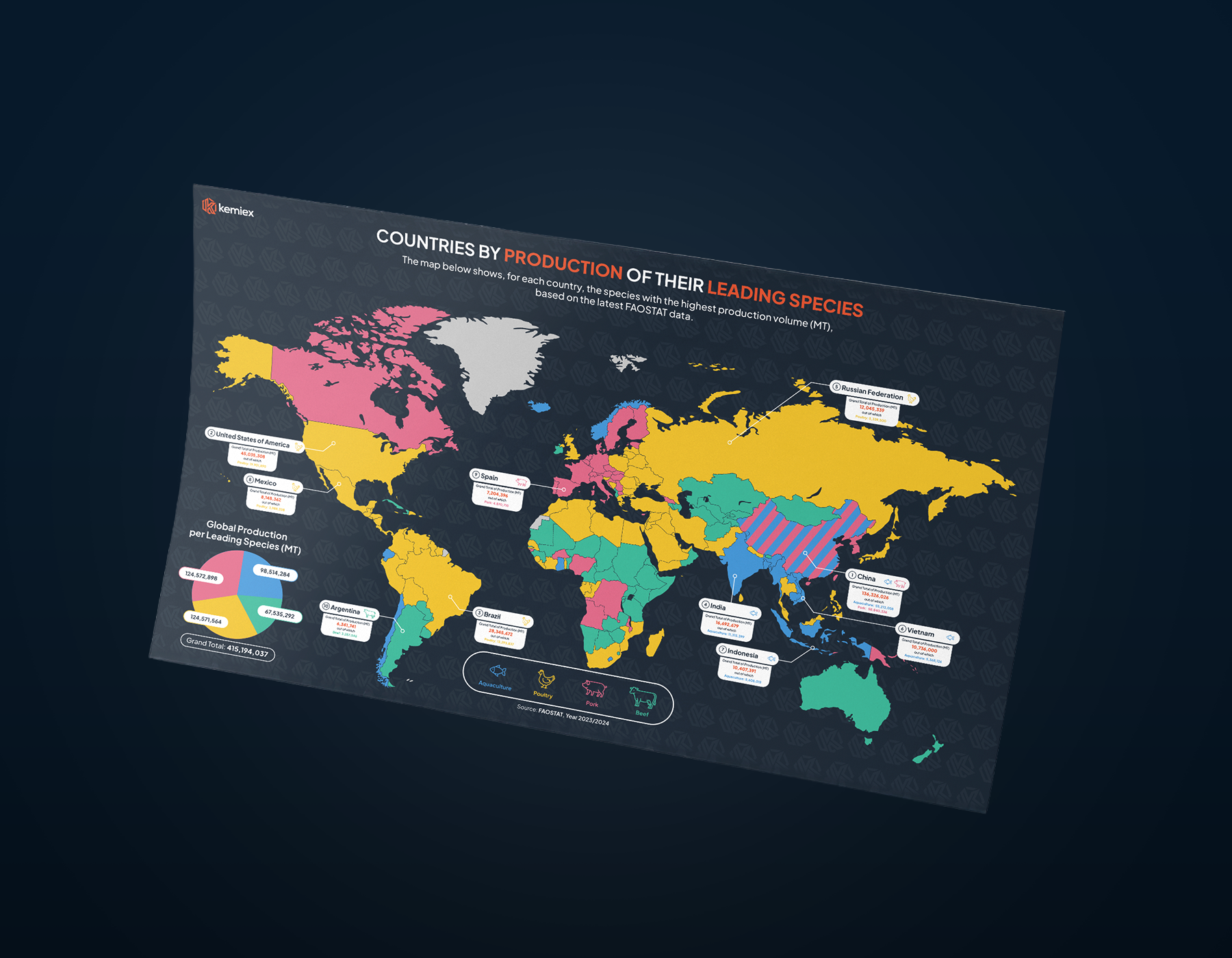
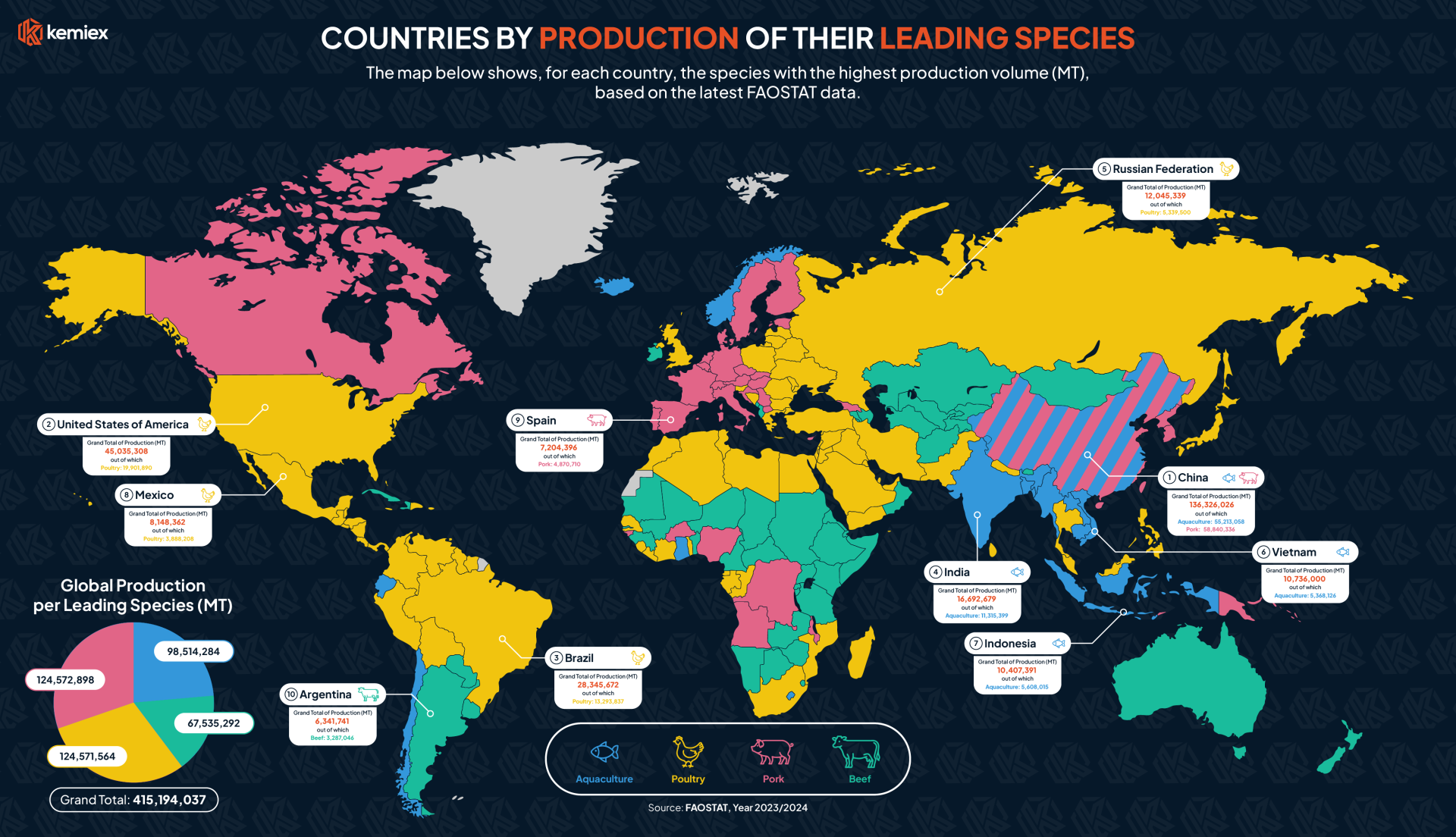
Global pork and chicken output are separated by just 1,334 MT, on a combined base of over 249 million MT, the tightest race between any two protein categories at that scale. That near-tie sits inside a wider pattern in which no single species dominates the world’s ten largest producers, chicken leads only four of them, fish from aquaculture three, pork two, and beef one.
The figures come from FAOSTAT for 2023/2024, covering four production categories: fish from aquaculture, cattle meat, chicken meat, and pig meat.
Chicken and pork are running a dead heat worldwide
The closest race sits outside any single country.
Worldwide pork production reached 124,572,898 MT in 2023, against 124,571,564 MT of chicken, a difference of just 1,334 MT on a combined base of over 249 million MT.
Fish from aquaculture followed at 98,514,284 MT and beef at 67,535,292 MT, for a grand total of 415,194,037 MT across the four categories. At that scale, a gap this small is effectively a tie.
China’s lead sits on pork and fish almost equally
China’s total of 136,326,026 MT across the four categories is itself split almost in half.
Pork stands at 58,840,336 MT and fish from aquaculture at 55,213,058 MT, a gap of 3,627,278 MT, or under 3% of China’s total, with chicken and beef making up the remaining 16%.
At a margin that tight, calling China simply pork-led or aquaculture-led understates how evenly its own production is split, and it ends up mirroring the same divide running across the top ten as a whole rather than standing apart from it.
Fish leads three of the top ten, beef only one
India, Vietnam, and Indonesia are each led by fish from aquaculture, at 68%, 50%, and 54% of their national totals respectively, the three highest concentration levels in the table.
Chicken leads in four countries, the United States, Brazil, Russia, and Mexico, at a fairly consistent 44% to 48% of national output in each case, which points to broad-based production rather than a single dominant category.
Argentina is the only beef-led country in the top ten, at 52% of its total, and Spain is the only country besides China led by pork, at 68%, the highest single-species concentration in the ranking outside China’s evenly split lead.
Top ten producers by total output, 2023/2024
MT: metric tonnes. Source: FAOSTAT, 2023/2024.| Rank | Country | Total production (MT) | Leading species | Leading species (MT) | Share of national total |
|---|---|---|---|---|---|
| 1 | China | 136,326,026 | Pork (near-tied with fish) | 58,840,336 | 43% |
| 2 | United States | 45,035,308 | Chicken | 19,901,890 | 44% |
| 3 | Brazil | 28,345,672 | Chicken | 13,293,837 | 47% |
| 4 | India | 16,692,679 | Fish from aquaculture | 11,315,399 | 68% |
| 5 | Russian Federation | 12,045,339 | Chicken | 5,339,500 | 44% |
| 6 | Vietnam | 10,736,000 | Fish from aquaculture | 5,368,126 | 50% |
| 7 | Indonesia | 10,407,391 | Fish from aquaculture | 5,608,015 | 54% |
| 8 | Mexico | 8,148,363 | Chicken | 3,888,208 | 48% |
| 9 | Spain | 7,204,396 | Pork | 4,870,710 | 68% |
| 10 | Argentina | 6,341,741 | Beef | 3,287,046 | 52% |
Reading the pattern rather than just the numbers
A production ranking on its own does not explain why the split falls where it does, or whether it is holding or shifting.
Trade flows tracks import and export volumes and prices across more than 185 raw ingredients used in feed and food, the same categories mapped here, which is what turns a production snapshot like this into an understanding of where each market is actually headed.
It sits alongside the supply map within Market Radar, covering producer and plant-level detail for the same markets.
If you want to see how this data applies to the products you buy, get in touch with our team.