New IFEEDER and Kemiex Report Tracks Upstream Feed Additive Supply Chains
The methionine in animal feed can depend on the nylon industry. Vitamins A and E share building blocks with aroma and fragrance ingredients. Vitamin B3 is tied to herbicide production. These links sit far upstream, long before a feed additive reaches a feed mill.
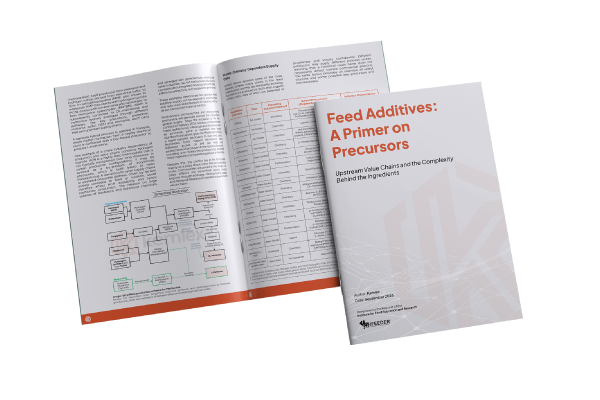
The American Feed Industry Association’s (AFIA) Institute for Feed Education and Research (IFEEDER), in collaboration with Kemiex, has released “Feed Additives: A Primer on Precursors.” The introductory report traces the upstream supply chains behind vitamins and amino acids used in animal feed and pet food.
It looks beyond the finished feed additive to the precursors, intermediates and other inputs needed to make it. A precursor is a compound that takes part directly in making the final molecule and is chemically transformed along the way.
What you’ll find in the report
Knowing what sits upstream helps explain why the supply and prices of feed additives can shift for reasons that have nothing to do with feed. The report makes these links visible, with flow charts and production routes for:
- Vitamin A, vitamin E, carotenoids and aroma ingredients
- DL-methionine and methionine hydroxy analogue (MHA)
- Vitamin B3, vitamin D3, choline chloride and more
Its overview table of more than 15 feed additives shows at a glance which precursors each one relies on and which other industries it is linked to. It is a practical reference for anyone working with vitamins and amino acids.

Note: To download the report successfully, please add Kemiex as an exception in your ad blocker (if you use one).
Why look upstream?
Supply chains for essential feed, food and health additives have changed notably in recent years. Events such as COVID-19, geopolitical and trade dynamics, drug shortages and shifts in market concentration have drawn more attention to how these chains are built.
Shared chemical inputs and infrastructure can make manufacturing more efficient. But they also create interdependencies. A disruption at one precursor, facility or geography can affect several manufacturers and finished products at once.
How feed additives connect to other industries
Many feed additives share precursors with industries that have no direct link to animal nutrition. A few examples from the report:
| Feed additive | Example precursors | Linked industry |
|---|---|---|
| Methionine (DL-methionine, MHA) | Acrolein, methyl mercaptan, hydrogen cyanide | Nylon, where hydrogen cyanide comes from acrylonitrile production |
| Vitamin A, vitamin E, carotenoids | Citral, linalool, beta-ionone, isophytol | Aroma and fragrance ingredients |
| Vitamin B3 (niacin, niacinamide) | Beta-picoline | Herbicides, through pyridine production |
| Choline chloride | Ethylene oxide, trimethylamine | Polyester (PET), through ethylene oxide |
| Vitamin D3 | Lanolin, cholesterol, 7-DHC | Wool and textiles |
| Vitamin K3 | 2-methylnaphthalene, chromic acid | Chromium chemicals and leather tanning |
A significant interruption in citral production, for example, could affect the supply and prices of vitamins, carotenoids and aroma ingredients at the same time. Likewise, a disruption in nylon supply chains could affect hydrogen cyanide availability and, in turn, methionine production.
Inside the report you can find many more feed additives, from vitamins to amino acids, and their precursors.
Risk looks different for every product
The assessment shows that supply chain vulnerabilities vary considerably by product. Three factors shape the risk:
- how complex the product’s upstream supply chain is
- which production route is used
- whether alternative chemical inputs or manufacturing pathways exist
Integrated industrial parks play a role too. There, manufacturers may share inputs, utilities and infrastructure. That brings efficiencies, but it can also create dependencies across multiple products and producers.
What this means for the industry
The findings show why supply chain resilience depends on looking beyond direct suppliers and finished ingredients.
The report also recognizes practical limits to transparency. These include proprietary manufacturing processes, supplier confidentiality and competition law.
Understanding these complexities can help stakeholders see where more visibility, diversification and collaboration could strengthen preparedness for future disruptions.
In their words
“Understanding nutrition and health supply chains requires looking beyond where a finished vitamin or amino acid is produced to the inputs and processes that make that production possible. Our evaluation shows how interconnected these supply chains can be, with critical precursors, intermediates and infrastructure often shared across manufacturers, products and even industries. Mapping those connections provides greater visibility into where opportunities and vulnerabilities may exist. Kemiex presents this primer for IFEEDER as a basis for further discussion and research.”
Stefan Schmidinger, Head of Market Research, Kemiex
“The precursors assessment looks upstream of the vitamin and amino acid supply chain, giving the feed and pet food industries a more complete picture of the complexity that could affect ingredient availability. Understanding the interconnected chemical and industrial supply chain for vitamins and amino acids equips industry leaders with the knowledge necessary to make decisions about the design, opportunities, risks and resilience of essential supply chains.”
Lara Moody, Executive Director, IFEEDER
Get the full report
“Feed Additives: A Primer on Precursors” is published by the American Feed Industry Association’s (AFIA) Institute for Feed Education and Research (IFEEDER), in collaboration with Kemiex. Download it to explore the full overview table, the production schemes and the detailed sections on each additive.
Note: To download the report successfully, please add Kemiex as an exception in your ad blocker (if you use one).
Frequently asked questions
1. What are vitamin and amino acid precursors?
A precursor is a compound that takes part directly in making a vitamin or amino acid and is chemically transformed in the process. Examples include beta-ionone for vitamin A, isophytol for vitamin E and methyl mercaptan for methionine.
2. Which feed additives does the report cover?
It focuses on chemistry-intensive feed additives such as vitamin A, vitamin E, carotenoids and DL-methionine, and explores how their precursor chains connect. The full list, with the key precursors for each additive, is in the report’s overview table.
3. How are feed vitamins and amino acids linked to other industries?
Many share precursors with unrelated sectors. Vitamin A and E precursors overlap with aroma ingredients, methionine can depend on nylon-related chemistry, and vitamin B3 is tied to herbicide production through pyridine.
4. Why isn’t it enough to know where a finished feed additive is made?
Many precursors, intermediates and facilities are shared across manufacturers, products and industries. A disruption upstream can reach several finished products at once.
5. Who published the report?
The American Feed Industry Association’s (AFIA) Institute for Feed Education and Research (IFEEDER), in collaboration with Kemiex. It was released on September 29, 2026.
6. Where can I read it?
Download it here, or find it on ifeeder.org.