
Monthly Market Pulse - August 2026
The August 2026 Monthly Market Pulse is out – Additives and feed markets turned mixed over summer, as weather, regulatory proceedings, currency headwinds and freight volatility add to sustained Mideast disruptions weighing on the sectors.
- The US – Iran conflict remains at stalemate, keeping energy prices volatile.
- 1H 2026 financial results from key producers confirm a divergence, with profitability increasingly reliant on portfolio mix while cost pressure is broad – based.
- Weather risk is compounding, as El Niño, heat, drought and low water on European rivers and the Panama Canal threaten feedstock and agricultural supply and costs .
Vitamins
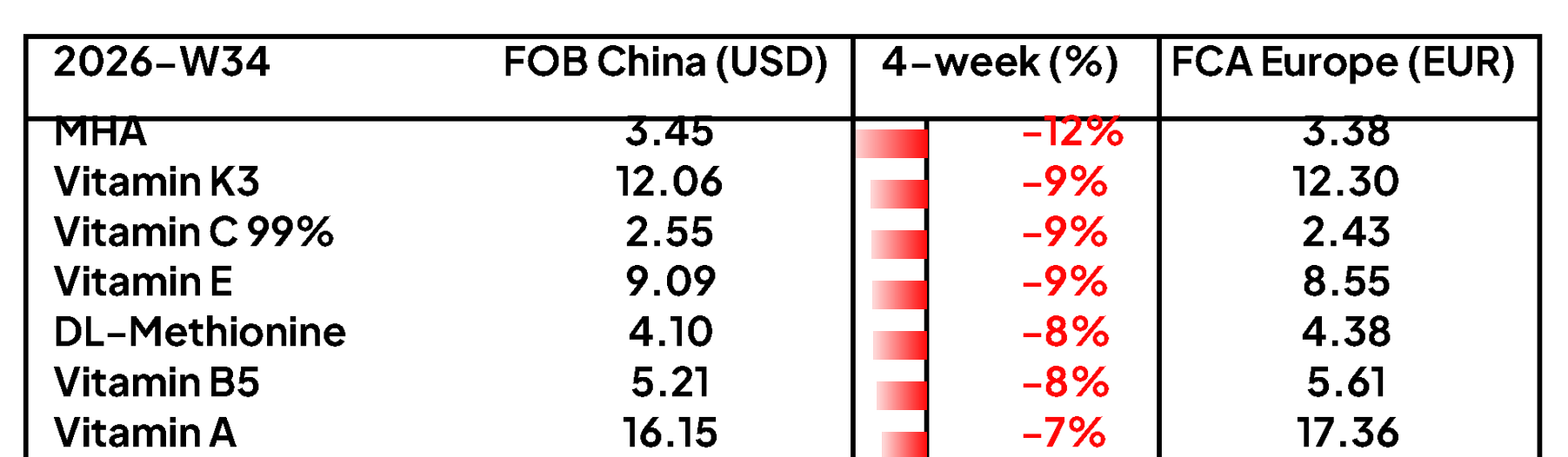
Vitamin prices generally continued to soften over the past month, though there are some early signs of potential stabilization , e.g . Vitamin E in China.
Zhejiang Garden’s 6’000 t/a VA powder project is complete, while its VB 6 (5’000 t/a) and Biotin (200 t/a) projects are in trial production and face delays.
Amino Acids
Amino acid prices fell the past month with some consolidation in recent weeks for select aminos (Lysine, Threonine, Valine) .
Economic Update
The US – Iran MOU, a 60 – day window to reach a broader settlement and reopen the Strait of Hormuz, has formally expired . The situation remains bleak and volatile . Brent crude is around 90 USD/barrel, below the conflict peak of 118 USD/barrel and above pre – conflict levels of 72 USD/barrel . Global oil reserves have continued to be drawn down at a near – record pace .
US headline CPI stayed high in July, rising +3.4% YoY, while the energy index is rising +14.7% YoY. Annual inflation in the Euro area also picked up in July, rising +2.9%, while China’s 2Q growth rate of 4.3% is the nation’s slowest pace in over three years.
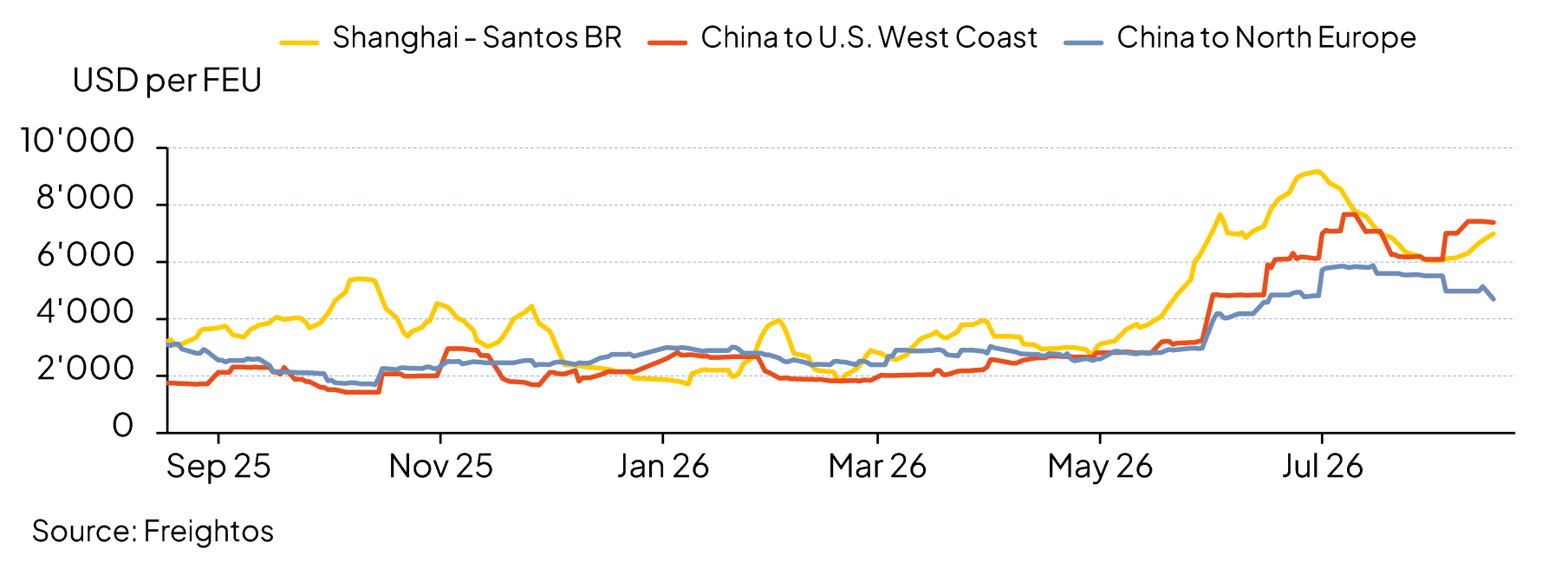
Transpacific routes have recently rebounded due to strong demand from a continued peak season . Asia – Europe routes have eased during the same period. Some carriers have pushed an early return to Red Sea transits .
Monthly Special
Weather events, including El Niño, continue to intensify as sea -surface temperatures reach record highs, placing this El Niño among the most severe episodes in decades .
In Latin America, heavier rain is typical in the south while the north has elevated drought risk . Asia – Pacific is one of the most vulnerable regions with drought and wildfire risks, potentially impacting Palm Oil in Southeast Asia or grains in India and Australia.
In Europe, a series of heatwaves , fires and lack of rainfall led to downward revisions for grain output (- 8% vs last season) .
If you’d like the full picture, including price movements, vitamins, amino acids, and the economic backdrop, download the full report or get in touch with our team for more information.